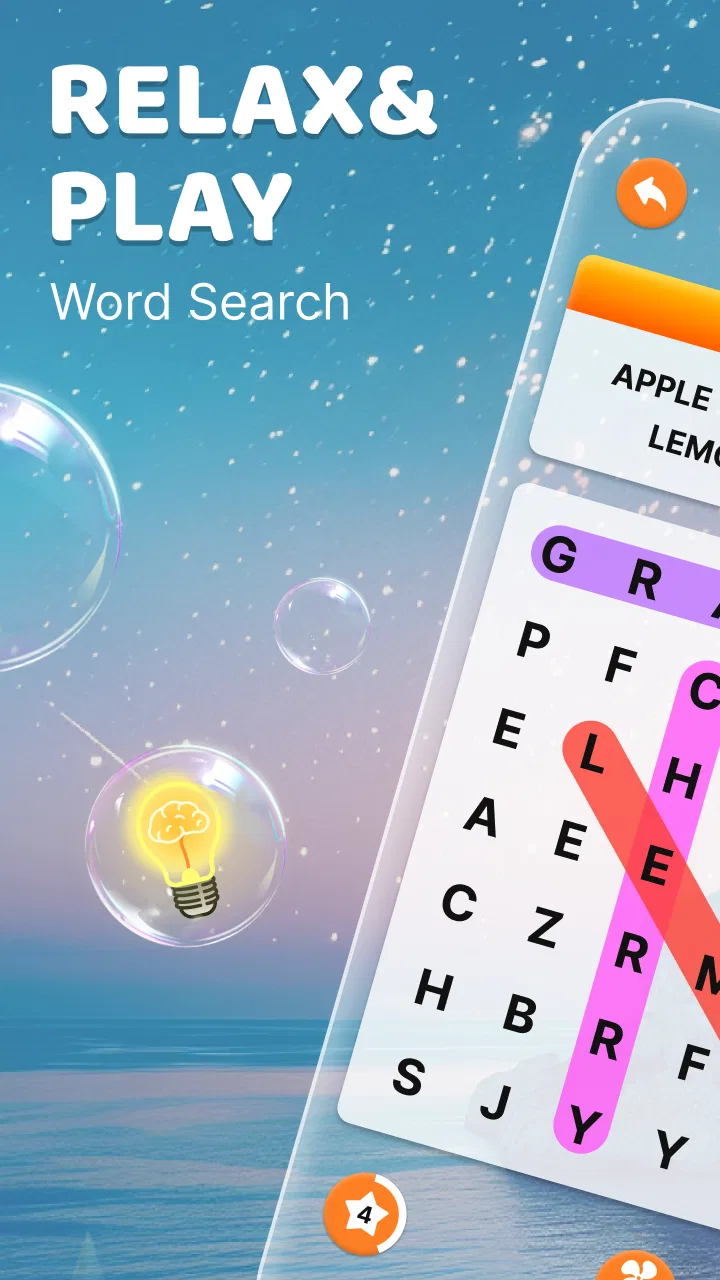
Word Search!
- 4.9
- Rating
- 10.00M
- Installs
- Free
- Price

 Analysis by App-foxy
Word Search is the kind of game I can open without preparing myself for a complicated session. The idea is familiar: scan a letter grid, find hidden words, and keep moving. What makes this particular version worth discussing is not a revolutionary twist, but how well that simple routine fits into ordinary spare time. I tested it as a quick break, a slower evening activity, and something to return to after the first burst of novelty had passed. My conclusion is positive, with one important qualification: it works best when you want a calm word puzzle rather than a demanding brain-training system or a deep competitive game.
Word Search is a free word game from Mindful Daily Puzzles, aimed at Everyone and available for devices running Android 6.0 or later. Its listing shows a 4.9 average from around 235 thousand ratings, while the game has passed 10 million installs. Those figures suggest that the straightforward format has found a large audience, but popularity alone does not guarantee lasting value. The more useful question is whether the daily habit remains pleasant once the basic satisfaction of learning the interface disappears.
How the first week feels
During the first few sessions, the appeal is immediate. I do not need to learn an elaborate control scheme, understand a story, or build a character before playing. I simply look for words in the grid and trace them. That low entry barrier matters on a phone, especially when I have only a few minutes and do not want to spend half of that time remembering where everything is.
You May Also Like

 Pandora - Music & Podcasts
Pandora’s Music Is Easy to Start, but Harder to Recover
Pandora’s strength is its low-effort path from a seed to a station. Its weak spot is how much confidence it asks you to place in connection, setup, and quiet recovery.

 AccuWeather: Weather Radar
AccuWeather Review: A Quick, Clear Forecast for Everyday Decisions
For everyday plans, the best forecast is the one you can understand quickly. AccuWeather makes rain timing, radar, and local conditions easy to act on, with a few trade-offs.

 Hill Climb Racing
Why Hill Climb Racing Still Turns Crashes Into One More Run
A tiny car, a bumpy hill and one more upgrade: Hill Climb Racing keeps resurfacing because its simple chaos makes every near-miss feel personal.

 AliExpress - Shopping App
AliExpress Makes Global Shopping Feel Personal, but Shoppers Bear the Risk
AliExpress turns a global marketplace into a pocket-sized discovery engine. Its reach is useful, its shopping loop compelling, and its trade-offs easy to miss.

 Lords Mobile: Kingdom Wars
Lords Mobile Is a Kingdom-Building Routine, Not a Quick Match
A case-by-case verdict on the building, battles, device demands, and social commitments that make Lords Mobile rewarding for some players and exhausting for others.

 PDF Scanner app - TapScanner
TapScanner Makes Paperwork Easier to Capture, Check, and Share
TapScanner makes scanning with a phone feel less like a rescue operation and more like a dependable step in getting work done. Its capture tools are useful, though not flawless.
More From Our News Desk
View All News


The game belongs firmly to the traditional word search puzzle category, so its strongest quality is accessibility. Someone who already enjoys printed puzzle books will understand the basic rhythm at once. Someone less comfortable with mobile games can also start without feeling lost. The visual task is familiar, and the interaction is direct enough that the focus stays on scanning letters instead of operating the app.
My first-week enjoyment came from the small tension between speed and accuracy. At the beginning, I wanted to sweep across the board quickly, but rushing made obvious words harder to see. Slowing down, checking diagonal lines, and changing the direction of my search often worked better than staring at the same cluster. That makes each short session mildly absorbing without turning it into an exhausting test.
A useful way to play is to divide the grid into zones rather than searching randomly. I usually start with the longer-looking words or unusual letter combinations, then inspect rows, columns, and diagonals systematically. This is not a special mode or hidden mechanic; it is simply a practical habit that makes the game feel less dependent on luck. It also gives the activity a little more structure when a puzzle initially looks crowded.
The free price makes experimenting easy. I could try it during a waiting period without deciding whether the game deserved money first. That is particularly helpful for families or casual players who want a low-commitment puzzle. The Everyone age rating also makes its general tone easy to understand: this is a broadly approachable activity, not a game built around mature themes or intense action.
Still, the first week can flatter almost any simple puzzle. New players are learning the visual style, discovering how quickly they can identify patterns, and enjoying the satisfaction of completing boards. The real test is what happens when the interface becomes familiar. If you need constant surprises, story progression, or a strong sense of personal achievement, the early appeal may not be enough to carry the experience by itself.
A practical break rather than a full gaming session
I found the best everyday use case during a short afternoon pause. Instead of opening a social feed and losing track of time, I could play a puzzle, stop when the break ended, and return to what I was doing. The game suits that pattern because its central action is easy to resume and does not demand a long uninterrupted commitment.
It also works before bed for people who prefer a quiet mental activity to something noisy or competitive. I would not call it a guaranteed sleep aid, since searching can become surprisingly absorbing when a final word refuses to appear. However, compared with an action game or a fast multiplayer alternative, it creates much less pressure. The calmer pace is one of its most dependable advantages.
For children, the basic word-finding task can offer practice with spelling recognition and visual attention, but I would still treat it as entertainment rather than a complete educational tool. Adults can use it in much the same way: as a light exercise for concentration, not as proof of improved memory or intelligence. That distinction keeps expectations realistic and prevents the game from being judged by a promise it does not need to make.
What remains after the novelty fades
After several weeks, the question changes from “Is this pleasant?” to “Why should I open it again?” The answer depends heavily on what I want from a mobile game. Word Search has recurring value for players who enjoy repetition with small variations. Finding words remains satisfying because the task is simple enough to understand but active enough to require attention.
Its month-to-month strength is routine. I can fit a puzzle into a commute, a lunch break, or a few quiet minutes at home. That makes it more sustainable than games that require a large time investment every time they are opened. The format is also easy to share informally: two people can look at the same board and compare how they approach it, even without turning the experience into a formal competition.
There is a useful distinction between recurring value and endless value. A puzzle can remain enjoyable for a long time without becoming more sophisticated. This game offers the former more convincingly than the latter. If I want a dependable small activity, it earns a place on my phone. If I expect a deep progression system, evolving strategy, or a reason to master advanced play, I will eventually look elsewhere.
Compared with paper word-search books, the mobile format is more convenient. I do not need to carry a book and pen, and I can play whenever the phone is already in my hand. The screen also makes marking words quicker and cleaner than circling them on paper. On the other hand, paper has a tactile quality and a more deliberate pace that some puzzle fans may prefer. For a person who enjoys physically writing or highlighting every discovery, the app cannot fully replace that feeling.
Compared with crossword games, the experience is less dependent on recalling definitions or producing answers from clues. That makes Word Search friendlier when I am tired or when I want a puzzle with less linguistic pressure. The trade-off is that it may feel less rewarding to players who enjoy vocabulary knowledge, wordplay, or solving an answer from a carefully constructed clue.
Compared with anagram games, it asks more of my visual scanning than my ability to rearrange letters. Compared with timed competitive word games, it is less stressful and usually easier to pause mentally. Those differences are important when choosing a daily puzzle. The right alternative is not necessarily better; it may simply match a different mood.
Small techniques that improve the long-term experience
My first useful technique is to avoid searching for every word in the same way. I look for distinctive letter pairs, uncommon endings, and the longest entries first. Once one word is found, I use its position to reset my eyes before starting the next search. This prevents the common problem of repeatedly scanning the same area while overlooking a word in a corner.
My second technique is to change the viewing distance. Holding the phone slightly farther away can make the whole grid easier to read, while moving closer helps when only a few letters remain. It sounds minor, but word searches often become tiring because the player keeps the same visual posture for too long. A quick change of focus can be more useful than playing faster.
My third recommendation is to stop before frustration turns the puzzle into a chore. When I cannot see the final word, I am tempted to keep staring until the board becomes a blur. Taking a short break and returning with fresh eyes is usually more effective. This is one reason the game works well as a habit: it does not punish me for leaving and coming back later.
These habits also reveal the game’s limits. The core challenge is mostly perceptual, so improvement can make familiar puzzles feel easier rather than deeper. Players who enjoy measuring progress through increasingly complex tactics may find that the satisfaction levels off. The game is better at providing a reliable mental pause than at creating a long-term mastery journey.
Maintenance, friction, and reasons to stop
A good casual game should be easy to maintain, and this one has a low mental maintenance burden. I do not need to remember a complicated build, preserve a streak, or keep track of a large collection before the next session makes sense. I can leave it alone for days and return without feeling behind. That is a major advantage for anyone whose gaming time is irregular.
The same simplicity can become a weakness. Because the central action stays so consistent, fatigue may arrive before the game itself becomes difficult. I notice it when I start finding words mechanically rather than feeling engaged. At that point, switching to a crossword, an anagram puzzle, or even a paper book is better than forcing another round.
Another possible source of fatigue is visual repetition. Scanning grids asks the eyes to perform a similar job again and again. I recommend taking breaks, increasing text size where the device allows it, and avoiding long sessions if the letters begin to swim together. This is practical advice rather than a criticism of one particular screen: word-search games naturally depend on sustained visual attention.
The game is also not the right choice for people who need a strong sense of narrative or social interaction. There is no reason to open it for character development, exploration, or a dramatic story. Likewise, players who want a demanding vocabulary challenge may prefer a crossword or a word-building game. Word Search succeeds by reducing friction, and that means it deliberately leaves out many systems that create depth elsewhere.
One question I would ask before installing is whether I enjoy looking for patterns more than solving clues. If the answer is yes, the game’s straightforward design is likely to feel relaxing. If I prefer being asked a question and reasoning toward a precise answer, the basic search format may seem passive. Neither preference is wrong, but it changes how quickly the novelty wears off.
Another practical question is whether free access matches your expectations. Since the game is free, it is easy to test without financial commitment. I would approach it as a casual download rather than as a premium puzzle replacement. That mindset makes the experience more satisfying because I am judging it by the quality of its small daily sessions, not expecting the breadth of a large paid game.
The current version is 1.1.97, and the game was released on November 13, 2023. Those details place it as a relatively recent mobile title with an established audience rather than an obscure experiment. I would still keep expectations focused on the actual activity: the value comes from the word grids and the convenience of returning to them, not from treating the version number as a promise of major change.
Who will keep it installed?
I think Word Search earns lasting space for people who want a quiet, repeatable puzzle that can be played in short bursts. It is especially suitable for casual players, fans of traditional word-search books, and anyone who likes a game with almost no learning curve. It can also suit households looking for an accessible activity that does not rely on action, competition, or mature content.
It is less suitable for players who need escalating complexity to stay interested. If your ideal game includes elaborate goals, strategic decisions, social competition, or a campaign, this will probably become a temporary download. The same applies if you dislike visual scanning or find repeated letter grids monotonous. No amount of convenience changes the fact that the central task remains narrow.
For my own use, the strongest routine is to treat it as a five-minute reset rather than a main hobby. I open it when I want to focus on one small task, complete as much as feels comfortable, and put the phone away. That approach preserves its relaxing quality and reduces the chance that repetition will become tiring. It also makes the game easier to keep installed even during weeks when I am not playing every day.
The 4.9 average and large install base show that many players respond well to this formula, but I would not use those figures as a substitute for personal fit. A highly rated word search can still be wrong for someone who wants clues, story, or competition. The useful takeaway is that the game has broad appeal within its narrow purpose, not that it replaces every other word puzzle.
After the first week, the game’s charm becomes less about discovery and more about dependable access. After a month, its value depends on whether I appreciate that dependable rhythm. I do, provided I keep sessions short and accept that the game is intentionally modest. It does not need to become a complex system to be worthwhile; it simply needs to make a small break feel better than an empty scroll through a feed.
My final recommendation is therefore measured but clear: try it if you want a free, approachable word puzzle for calm, repeatable sessions. The developer, Mindful Daily Puzzles, has positioned it around a familiar activity that remains easy to pick up, and that simplicity is both its greatest strength and its main limitation. It earns a permanent place when you value reliable short sessions over constant novelty. If your interest fades once the basic search pattern feels familiar, uninstalling it is reasonable; if you enjoy that pattern as a small daily ritual, it is an easy game to keep coming back to.
FAQs for Word Search!
01What features does Word Search! offer to enhance user experience?
Word Search! offers a variety of features designed to enhance user experience, including multiple difficulty levels, themed word categories, and daily challenges. The app also supports offline play, allowing users to enjoy puzzles without needing an internet connection. Additionally, there are hints available to help players when they get stuck, making it accessible for all skill levels.
02Is Word Search! free to download and play?
Yes, Word Search! is free to download and play on both Android and iOS devices. However, the app includes optional in-app purchases that allow users to unlock additional features, such as ad-free gameplay and exclusive puzzle packs. These purchases are entirely optional and not necessary for enjoying the core game.
03Does Word Search! include any social or multiplayer features?
Word Search! incorporates social features allowing players to connect with friends through leaderboards and shared achievements. While it doesn't offer direct multiplayer modes, the competitive aspect comes from comparing scores and completing challenges faster than friends, fostering a sense of community and friendly competition.
04Are there any advertisements in the Word Search! app?
Yes, Word Search! includes advertisements, as it is a free app. Ads typically appear between puzzles or at the bottom of the screen. For players who prefer an uninterrupted experience, there is an option to purchase an ad-free version of the app through an in-app purchase.
05What age group is Word Search! suitable for?
Word Search! is suitable for a wide range of age groups, from children to adults. The app's design is family-friendly, with curated word lists that cater to various interests and educational levels. It's an excellent tool for developing vocabulary and cognitive skills, making it an enjoyable and educational activity for kids and adults alike.
Pros
- User-friendly interface
- easy navigation.
- Variety of levels to challenge all ages.
- Offline mode available for on-the-go play.
- Hints system helps when you're stuck.
- Visually appealing with colorful themes.
Cons
- Ads can be intrusive during gameplay.
- Limited language options available.
- No multiplayer feature for social play.
- Progress sync issues across devices.
- Occasional lag on older devices.

Word Search!
Gallery